A growing share of your prospects no longer type a query into Google to scan ten blue links. They ask ChatGPT, Perplexity, Gemini or Claude, and read a synthesized answer that cites a few sources — or none at all. The right question is no longer just “how do I rank?” but “how do I get cited, mentioned, recommended by a generative AI?”. That is the purpose of GEO (Generative Engine Optimization), and the heart of your AI visibility.
In one sentence: GEO means making your brand exist as a clear, well-contextualized entity associated with the right sources, so a generative AI cites it; it works across four fronts — the entity, third-party mentions, extractable content and technical foundations — and is steered through rigorous measurement rather than guesswork.
And your brand — does ChatGPT recommend it?Measure your presence and spot the brands cited in your place. No credit card.
This guide is written from a practitioner’s point of view. I am an SEO and GEO consultant, and I co-build Cockpyt AI, a tool for tracking brand visibility in LLM answers. I don’t just state principles: I give you the measurement protocols that verify whether what you’re doing works. And I keep a bias toward epistemic honesty. When a practice is solidly documented, I say so. When it’s a reasonable but unproven hypothesis, I say that too.
Part I — Understanding GEO
What is the difference between SEO and GEO?
In classic SEO, you optimize a page so it appears in a list of results. The user sees your link, clicks, lands on your site. In GEO, the generative engine doesn’t necessarily send you traffic: it reads your content, digests it, and restitutes it — reworded — inside an answer. You can be the source of an answer without receiving a single click.
This shift changes the objective. It’s no longer solely about the click, but about presence in the answer. Being named. Being cited. Being recommended. And since the model doesn’t reason in pages but in entities and relationships, your job is to make your brand exist as a clear, well-contextualized entity, associated with the right concepts and the right competitors.
You no longer work a keyword, you work an entity within a semantic context. If you ask a model “what are the best AI visibility tracking tools?”, it doesn’t consult an index of pages ranked by authority. It restitutes passages where those tools appear together, in a shared context. The question becomes: does your brand appear, repeatedly, alongside the leaders of your category, in credible sources?
GEO doesn’t replace SEO, it builds on it. Many generative engines query a search engine to fetch fresh information at answer time. If your page isn’t indexable, readable and technically sound, it will be neither ranked nor retrieved by the AI. Technical SEO remains the entry ticket.
A few markers to grasp the scale of the shift. According to Previsible’s 2025 AI Traffic Report, AI-referred sessions jumped 527% year over year across the first five months of 2025. Research relayed by Stacker in March 2026 indicates that around 64% of citations produced in AI answers point to third-party sources rather than the brand’s own site. In other words: your AI visibility plays out largely on ground you don’t own.
How do generative engines actually work?
A generative engine produces its answers from two reservoirs: what it learned during training, frozen at a certain date, and what it fetches in real time when it needs to. These two reservoirs don’t follow the same rules, and your strategy must address them differently.
Training data: the long memory
During training, the model ingests vast text corpora. Some sources are overrepresented and therefore disproportionately influential: Wikipedia, large community platforms like Reddit, top-tier media, structured bases like Wikidata. If your entity is present and well described in these sources, the model “knows” who you are, even without searching the web. That’s the long memory: slow to build but durable.
An underrated consequence: for certain queries, the model decides which brands to mention from what it learned, before launching any search at all. If you don’t exist in its training-derived “consideration set”, no last-minute page optimization will get you in for that query.
Grounding: the fresh memory
When the model needs recent or precise information, it queries a search engine, retrieves pages, and relies on them to answer. This is grounding, often implemented via a RAG (retrieval-augmented generation) architecture. This is where your SEO becomes directly decisive again.
Chunking and citability
When a model retrieves a page, it doesn’t read it like a human. It splits it into fragments — chunks — and selects those that best answer the sub-question at hand. Content that cites well is content that splits well: a crisp definition opening a paragraph, a self-contained answer, a comparison table, a sourced statistic. A paragraph buried in context, meaningful only alongside what precedes it, cites poorly.
The dual reservoir, summarized
Training (long memory): worked through presence in major corpora — Wikipedia, Wikidata, Reddit, media. Slow, durable, decisive for entering the consideration set. Grounding (fresh memory): worked through SEO and page citability. Fast to influence, dependent on indexing and content extractability.
From this dual mechanism follows a counterintuitive truth: being mentioned on Wikipedia, in an active Reddit thread or a trade publication often weighs more than a perfectly optimized page on your own domain. These sources are overrepresented in training, and perceived as credible third parties, hence less suspected of self-promotion.
What is query fan-out and why does it change everything?
When a generative engine decides to fetch information, it usually doesn’t relaunch your question as is. It breaks it into several reworded sub-queries — the query fan-out — then runs those searches in parallel and synthesizes the results. Understanding this fragmentation means understanding where your visibility really plays out.
A single prompt can generate 4 to 8 sub-queries for a simple question, and up to 12 to 20 for a complex one. The engine rephrases with the entities it deems relevant, and often adds modifiers: “best”, “top”, “reviews”, “comparison”, or the current year. Each sub-query is a fresh chance to appear — or to disappear.
Not all queries trigger a search
A key point to avoid scattering your effort: only a fraction of prompts actually trigger a web search — around 31% according to available observations. And that rate varies widely by intent.
| Intent type | Probability of a web search | GEO priority |
|---|---|---|
| Local | ~59% | High |
| Commercial | ~53.5% | High |
| Comparative | High | High |
| Purely informational | ~18.7% | Low (work the training layer) |
The lesson is direct: if you want visibility through grounding, target commercial, comparative and local queries — the ones that actually trigger a search.
Behavior varies radically by model version
Here is the most important lesson, and the one almost no one measures. A study by Writesonic on fifty prompts illustrates the scale of the phenomenon between two successive versions of the same engine. Where one generation sent roughly one sub-query per prompt, the next sent nearly eight and a half on average. Your competitive surface was multiplied by eight, overnight, without warning.
More striking: across those fifty prompts, the most recent version launched 156 queries using the site: operator, when no other version used a single one. The model then goes straight for your pricing pages, your documentation, your profiles on third-party platforms. And the overlap of cited sources between two versions was only around 7%: optimizing for one version tells you almost nothing about the other.
The measurement implication: if your GEO visibility tracking only counts mentions appearing on the initial prompt, you’re measuring a fraction of reality — potentially an eighth — and on a single model version. Fan-out forces you to measure at the sub-query level, and per version.
Part II — Visibility levers
How do you consolidate your entity in the eyes of AIs?
If the model reasons in entities, the first task is to make yours exist clearly and unambiguously. An entity isn’t a character string; it’s an identifiable node in a graph of meaning — a brand, a person, a product — linked to other nodes by typed relationships. As long as your brand floats as a mere word, the model can’t mobilize it with confidence.
Wikidata, the disproportionate asset
If you had to keep just one entity lever, it would be Wikidata. This structured, open base, massively ingested by the large models, works like a machine-readable identity card. Appearing there, correctly linked, gives the model a reliable anchor to disambiguate you. For the effort involved, it’s one of the best impact-to-cost ratios in GEO.
A few useful Wikidata properties
- P31 (instance of): declares what the entity is — a company, a person, a piece of software.
- P106 (occupation): for a person, their profession — useful for expert and founder profiles.
- P937 (work location): a geographic anchor that reinforces the entity’s local context.
A caveat: Wikidata has its notability and verifiability rules. An item created without solid sources risks deletion. The right approach is patient: first build credible external references, then structure the item on top of them.
Schema.org and sameAs
On your own site, Schema.org markup in JSON-LD formally declares your entity. A clean Organization or Person block states exactly who you are. The most strategic property for GEO is sameAs: it links your entity to all your authority profiles elsewhere on the web — LinkedIn, professional bases, recognized directories, industry associations.
An often-neglected hygiene rule: never point a sameAs to your own domain, it’s circular and useless. Reserve it for third-party profiles that validate you from outside. And mind consistency: the same entity name, address and legal identifiers everywhere.
Disambiguation: the prerequisite to everything
Before any visibility campaign, make sure your entity isn’t confused with another. If your brand shares its name with a city, a product or a famous person, the model may blend contexts. Disambiguation comes from rich, repeated context: systematically associate your name with your sector, your location, your area of expertise.
Brand mentions or backlinks: what matters most in GEO?
For twenty years, the backlink reigned as the dominant authority signal. In GEO, the available data suggests a reversal: it’s no longer the link that counts most, it’s the mention.
Ahrefs studied 75,000 brands to identify the factors correlated with presence in generative answers. Result published in August 2025: web mentions of the brand correlate with AI visibility at 0.664, more than three times more strongly than backlinks, at 0.218.
| Signal | Correlation with AI visibility | Source |
|---|---|---|
| Brand web mentions | 0.664 | Ahrefs, 75,000 brands, August 2025 |
| Backlinks | 0.218 | Ahrefs, 75,000 brands, August 2025 |
The point that truly breaks with classic SEO: an unlinked mention — your brand cited in a text, with no hyperlink — already carries signal. You don’t need to wrestle a backlink to exist in the eyes of an LLM. This widens the field of useful actions and eases negotiation, since getting a citation is often easier than getting a link.
Not all sources are equal. Muck Rack’s analysis of more than a million links cited by AIs reveals that around 82% come from earned media. And some platforms multiply your chances: according to industry observations, a brand mentioned on Reddit or Quora has roughly four times more chances of being cited, and presence on professional review platforms like G2, Capterra or Trustpilot multiplies citation chances by about three.
Turn these figures into actions
- Aim for earned media: light press relations, expert contributions, editorial pieces in your sector’s media.
- Infiltrate communities: Reddit, Quora, industry forums — through useful, authentic presence, never promotional spam.
- Tend to review platforms: a complete profile and real reviews on G2, Capterra or Trustpilot become direct sources for the models.
A note of caution: correlation isn’t causation. Heavily mentioned brands are often also large brands, popular for a thousand reasons. The 0.664 correlation points to a solid direction of work, not a mechanical guarantee. Treat it as a compass, and measure your results.
Co-mention and co-occurrence: how to be associated with the right players?
What matters isn’t only being named, but being named alongside the right entities, in the right context. This is the co-mention mechanism, probably the most underexploited signal in GEO.
When a model answers “best AI visibility tracking tools”, it retrieves passages where those tools appear together, in the same semantic context, then synthesizes. If your brand systematically appears alongside the recognized leaders of your category, it gets modeled as belonging to the same cluster. Even without a link. Repeated textual co-occurrence, in credible sources, creates the association.
Co-mentions to aim for concretely:
- A thread on an industry forum where someone lists five tools in your category, including yours.
- A comparison article “X vs Y vs Z” — even if you didn’t write it.
- A podcast episode where the guest names three players in your market in the same sentence.
- A post by a recognized consultant benchmarking the ecosystem and including you.
To steer this, map the entities that should surround you. Four families are useful: geographic entities (your city, region, catchment area), professional ones (your trade, sector, certifications), authority ones (associations, labels, reference institutions) and co-mention ones (recognized competitors and peers).
The trap to avoid: co-mention isn’t manufactured through artificial lists or content farms. Models and platforms detect astroturfing better and better. Credible co-occurrence arises from real presence in real conversations. Patience beats manipulation.
How do you produce content that AIs can extract?
A model doesn’t reward elegant prose: it rewards what it can extract cleanly and restitute without risk of misreading.
One data point shapes the whole layout: according to Kevin Indig’s analysis published in his Growth Memo in February 2026, 44.2% of ChatGPT citations come from the first third of an article. The consequence is clear: put the essential up top. Your entity’s name, your main claim, the direct answer to the question must appear within the first 500 characters of the page.
Think in self-contained chunks. Each format below produces fragments the model can extract in isolation:
- The definition opening a paragraph: the first sentence answers, the rest develops.
- The question-and-answer format, where each answer stands alone without its context.
- Bulleted and numbered lists, which isolate distinct items.
- Comparison tables, especially valued for comparison queries.
- Sourced, dated statistics, easy to cite with their attribution.
At site scale, organize your expertise around pillar pages — reference content covering a topic in depth — surrounded by satellite articles each addressing one precise sub-question. This structure covers the range of fan-out sub-queries and signals to the model that you treat the domain thoroughly.
A common pitfall is over-optimizing to the point of robotic text. The very qualities that make content extractable — clarity, direct answers, clean structure — also make it more pleasant for your human readers. Write to be understood first; machine citability almost always follows.
Part III — Technical foundations
Is your site technically readable by AI crawlers?
You can have the best entity and content strategy in the world: if AI crawlers can’t access your pages, or only see an empty shell, it all collapses. This is the least glamorous and most differentiating part.
AI crawlers generally don’t execute JavaScript
Here is the most costly and widespread error. Most generative-engine crawlers are simple HTTP crawlers: they fetch the raw HTML and don’t render JavaScript. If your critical content — titles, paragraphs, FAQ, testimonials — only appears after scripts execute, these crawlers see nothing. Many sites built with page builders load most of their content in JavaScript, and are thus largely invisible to AIs without knowing it.
To know what an AI crawler sees of your page, two simple tests:
- Disable JavaScript in your browser’s developer tools, then reload the page. If you only see a loading screen or a blank page, your content is invisible to crawlers.
- Fetch the raw HTML from the command line and search it for your key titles. If they’re not there, they’re not in the static HTML.
On a Unix or macOS system, simulating an AI crawler’s agent:
curl -A "GPTBot" https://your-site.com/page/ | grep -i "title\|h1\|h2"On Windows, in PowerShell, the equivalent of grep is Select-String:
curl -A "GPTBot" https://your-site.com/page/ | Select-String -Pattern "title|h1|h2"The structural fix: if content is invisible without JavaScript, two routes — server-side rendering, or at least ensuring critical content is in the static HTML on first load. Deferred elements (lazy-loaded logos, AJAX forms, dynamic accordions) often stay out of crawlers’ reach.
Crawler access: robots.txt and beyond
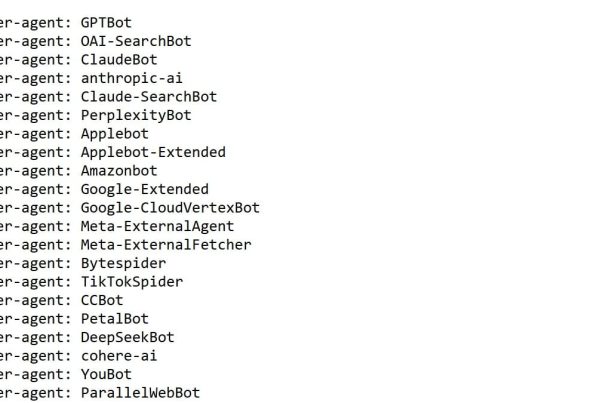
First check: does your robots.txt allow AI crawlers? The main agents include GPTBot, ClaudeBot, PerplexityBot, Google-Extended, and others. A too-broad Disallow, or a rule inherited from an old setting, can block them without your knowing.
The sneakiest trap is the application firewall, invisible in robots.txt. Many hosts and security services (WAF, anti-DDoS modules, server protections) automatically block or challenge certain crawlers, sometimes solely based on a flagged IP address. The crawler then receives an error (often a 403 or 503 code) or a JavaScript challenge it can’t solve, and leaves without indexing anything. You think your site is open; it’s closed at the server layer. To diagnose it, check server logs and look for 403 or 503 responses served to AI crawler user-agents.
Which structured data should you deploy for GEO?
Structured data in JSON-LD speaks to machines in their own language. Where free text must be interpreted, markup declares explicitly: this is an organization, here is a frequent question and its answer, here is a customer review and its rating. For generative engines, these declarations reduce ambiguity and reinforce trust.
Four schema families deserve priority attention:
- Organization / Person: declares your entity, its legal identity, its identifiers, and its network via sameAs.
- FAQPage: structures your questions and answers, a format models favor for conversational queries.
- Review / AggregateRating: turns your testimonials into explicit authority signals.
- Service / Product: precisely describes what you offer, with the context that aids disambiguation.
A nuance on reviews. Since a Google update in September 2023, self-hosted reviews marked up on a LocalBusiness page no longer generate stars in classic results — those stars now come only from the Google Business Profile. However, AggregateRating markup keeps its usefulness for generative engines. Keep it in your JSON-LD for the LLMs, but direct your review-collection efforts to Google Business Profile for traditional SEO.
FAQPage markup also offers an elegant workaround for dynamic content: even if an accordion FAQ is invisible in the raw HTML, the questions and answers declared in the schema remain machine-readable.
The golden rule of JSON-LD: marked-up content must faithfully reflect the page’s visible content. Declaring information that is absent from or contradictory to the page is bad practice, penalizable and counterproductive. Markup clarifies; it doesn’t lie. And always validate your blocks before publishing.
Should you create an llms.txt or ai.txt file?
No topic in this guide demands more caution. The llms.txt and ai.txt files are regularly presented as GEO must-haves. The reality is more nuanced.
The idea is appealing. The llms.txt file, placed at the site root, aims to be an AI-readable identity card: a synthetic description, the list of important pages, key figures, contact. The ai.txt file, modeled on robots.txt, aims to be a rights declaration: allow citation while forbidding training, for example.
But it must be said plainly: there is currently no solid, public evidence that the major generative engines actually consult the llms.txt file to produce their answers or choose their citations. The main players haven’t confirmed systematic use, and independent tests don’t demonstrate a clear effect. The standard remains emergent. The ai.txt case is just as uncertain: respecting a rights declaration depends entirely on each operator’s goodwill, and it carries no binding value in itself.
The reasonable position: these files are a low-cost bet, not a proven practice. Putting them in place takes little time and does no harm, provided they don’t contradict robots.txt. But attribute no magic power to them, don’t bill a client as if they were a demonstrated lever, and don’t divert toward them time that would be far better invested in the entity, mentions and technical foundations.
Part IV — Measurement and steering
Can you really measure your visibility in AIs?
Everything above is worthless if you can’t tell whether it’s working. GEO measurement is harder than in SEO: no stable average position, no official search volume, answers that vary from one run to the next.
The skeptical argument runs thus: “LLM answers are probabilistic and changing, so you can’t measure anything”. This argument confuses “you can’t measure like in SEO” with “you can’t measure at all”. Yet uncertainty measures perfectly well, provided you sample. An opinion poll doesn’t predict an individual’s vote; it does measure reliable trends at population scale. GEO measurement follows the same logic: you sample answers, aggregate, and track trends with variance thresholds.
Useful measurement distinguishes three dimensions, because they don’t carry the same value:
- Citation vs mention vs recommendation: being cited as a source, mentioned in passing, or actively recommended are three very different statuses.
- Position in the answer: being named first or at the bottom of a list doesn’t carry the same commercial weight.
- Sentiment: being cited favorably, neutrally, or as a counter-example changes everything. A negative mention isn’t a win.
Also segment by intent type. Your visibility on decisional and commercial queries — those that precede a purchase — is worth far more than your presence on general definition questions. A dashboard that blends the two masks the information that matters.
Which GEO measurement protocol should you apply?
A GEO measurement protocol rests on a simple principle: fix a stable method, apply it regularly, and interpret as significant only a gap that exceeds the noise. The method’s stability matters more than its sophistication.
- Define your money prompts. The scope doesn’t start from SEO keywords but from real conversational queries — the questions a prospect would type to find your offer. Define between ten and thirty. This reference set must stay stable for comparisons to mean anything.
- Set the engine and competitor scope. Decide which engines you track, and list three to five direct competitors. Your share of voice only makes sense relative to them: being cited in 30% of answers is excellent if your competitors top out at 10%, mediocre if they’re at 70%.
- Sample at a fixed cadence. A single measurement is worthless. Repeat each prompt several times, across several engines, at regular intervals — for instance fifteen or so weekly readings, with deeper audits when an anomaly appears. What matters is regularity: same day, same method, same prompts.
- Set variance thresholds in advance. Deciding the threshold before seeing the data protects you from hasty interpretations.
- Measure at the sub-query level. If you only count presence on the initial prompt, you ignore most opportunities. A mature protocol observes the full surface, per model version.
| Observed gap | Interpretation | Action |
|---|---|---|
| < 10% | Normal noise | None |
| 10 – 20% | To watch | Note it, observe the trend |
| 20 – 40% | Probable movement | Analyze possible causes |
| > 40% | Alert | Immediate in-depth audit |
How do you build a complete GEO audit?
Many GEO audits on the market stay superficial: they list generic recommendations with no hierarchy or measurement. Your differentiation lies in the rigor of the approach, across five phases.
- Scoping and money prompts. Define the perimeter: ten to thirty real conversational queries, the engines tracked, three to five direct competitors.
- Visibility baseline. Establish the zero state: share of voice per engine and per prompt, presence or absence, position in the answer, sentiment. It’s the equivalent of the initial crawl in SEO.
- Technical AI Readiness audit. Audit and score the foundation that conditions citability: crawler access, firewall behavior, JavaScript rendering of critical content, JSON-LD validity, speed and HTTPS. A criticality-weighted score makes priorities legible.
- Citation analysis. For each money prompt, identify the cited sources, then classify them on three axes: their type (your domain, a third-party platform, a media outlet, a competitor), their granularity (generic page or precise page), and their accessibility (self-service, editorial selection, or ranking). The deliverable is a matrix that reveals your angles of attack.
- Impact prioritization. Rank actions by their real GEO impact and their execution cost. One prioritized, contextualized recommendation beats ten generic ones.
The thread running through the audit: measure before acting, act on the foundation before the content, contextualize before listing. A credible GEO audit is recognizable in that it starts with a quantified baseline and ends with justified priorities — never the reverse.
Frequently asked questions about GEO
Does GEO replace SEO?
No. GEO builds on SEO. Generative engines query a search engine to fetch fresh information: without indexability and sound technical foundations, your page will be neither ranked nor retrieved. SEO becomes the entry ticket, GEO adds a layer on top.
How long does it take to see GEO results?
It depends on the lever. Technical foundations and markup produce fast effects on grounding. Entity consolidation (Wikidata, mentions, co-occurrences) belongs to the long memory: slow to build, but durable. Without regular measurement, you won’t be able to tell a real movement from noise.
Do you need to be present on ChatGPT, Perplexity, Gemini and Claude at once?
Ideally yes, because their behaviors differ widely — the overlap of cited sources between two versions of the same engine can drop to 7%. In practice, prioritize the engines where your prospects are, and measure each separately rather than aggregating a misleading global score.
Does an unlinked mention really have value?
Yes. It’s one of the major breaks with SEO. An unlinked mention, in a credible source and good context, already carries signal for an LLM. Ahrefs data (2025) shows that mentions correlate roughly three times more than backlinks with AI visibility.
Does an llms.txt file improve my AI visibility?
Nothing proves it to date. No solid public evidence demonstrates that the major engines consult this file for their answers. Deploying it remains a low-cost bet, provided you don’t present it as a proven lever nor devote time to it that would be better invested in the entity, mentions and technical work.
How do you measure visibility that changes with every answer?
Through sampling, like a poll. You don’t measure an absolute truth but a trend with bounded uncertainty. By repeating the same money prompts at a fixed cadence and setting variance thresholds in advance, you detect real changes beyond the noise.
Which third-party sources should you prioritize first?
Earned media dominates (around 82% of cited links per Muck Rack). Concretely: Wikipedia and Wikidata for the entity, Reddit and Quora for communities (about ×4 citation chances), and review platforms like G2, Capterra or Trustpilot depending on your sector (about ×3).
Sources
- Aggarwal, P. et al., “GEO: Generative Engine Optimization”, ACM KDD 2024 (arXiv:2311.09735).
- Ahrefs, correlation study on 75,000 brands (web mentions vs backlinks for AI visibility), August 2025.
- Stacker, research on the share of citations from third-party sources in AI answers, March 2026.
- Kevin Indig, Growth Memo, analysis of citation position within articles, February 2026.
- Writesonic, comparative study of fan-out behavior across model versions (50 prompts).
- Muck Rack, analysis of more than a million links cited by AIs (earned media share).
- Previsible, 2025 AI Traffic Report (growth of AI-referred sessions).
- Peec AI, analysis of more than twenty million fan-out queries.
Methodological note: in such a recent field, some of these sources are private studies not peer-reviewed. They indicate coherent directions of work, not established laws. Always verify the primary source and the freshness of a data point before turning it into a client argument.