You type a query into ChatGPT or Perplexity. Behind the scenes, the AI doesn’t launch a single search. It triggers dozens in parallel. This mechanism is called query fan out.
It breaks down every query into specific sub-queries covering all angles of a subject: definitions, comparisons, reviews, pricing, alternatives. If your site doesn’t answer these sub-queries, it falls off the radar of generative engines.
I am Florian Zorgnotti, SEO and GEO consultant in Nice. In this article, I provide a concrete audit framework and an action plan — specifically addressing the linguistic bias that penalizes non-English sites.
Key Takeaways:
- Query fan out breaks a query into dozens of sub-queries processed in parallel by AI engines (Gemini, ChatGPT, Perplexity).
- According to the Peec AI study (2026), 43% of ChatGPT fan-outs for non-English prompts are formulated in English — an invisible filter for French and international sites.
- Staying visible requires comprehensive semantic coverage, structured data (Schema.org), and a targeted bilingual content strategy.
- Use the QFO-ready audit checklist below to diagnose your site in a few minutes.
In summary: query fan out redistributes visibility to sites that cover a subject from all its angles. Monolingual, poorly structured, or single-keyword-focused sites are losing ground to AI engines.
What is query fan out? Definition and mechanism
Query fan out is a query expansion method used by generative engines. From an initial query, the LLM automatically generates dozens of specific sub-queries, executes them in parallel, and then aggregates the results to produce a single, structured response.
The 5-step principle
- Analysis — The AI detects the complexity of the query and identifies entities, intents, and ambiguities.
- Fan-out — It generates sub-queries covering every facet: semantic variations, implicit questions, secondary intents.
- Parallel Search — The sub-queries are sent simultaneously to the web, databases, and Knowledge Graphs.
- Synthesis — The AI compiles the results, applies a ranking algorithm (Reciprocal Rank Fusion), and builds a coherent response.
- Verification — If gaps remain, the system relaunch targeted searches.
The Google “Search with Stateful Chat” patent (August 2024)
The technology finds its origins in patent US20240289407A1, published by Mahsan Rofouei, Anand Shukla, Qing Liang et al. on August 29, 2024. Michael King (iPullRank), an American SEO expert, was one of the first to dissect this patent and analyze its implications.
This patent describes a 9-step process, from receiving the query to delivering a multi-source synthetic response with citations. The key finding: the query is now just a trigger for a much broader synthesis process.
Concrete example: how AI decomposes an SEO query
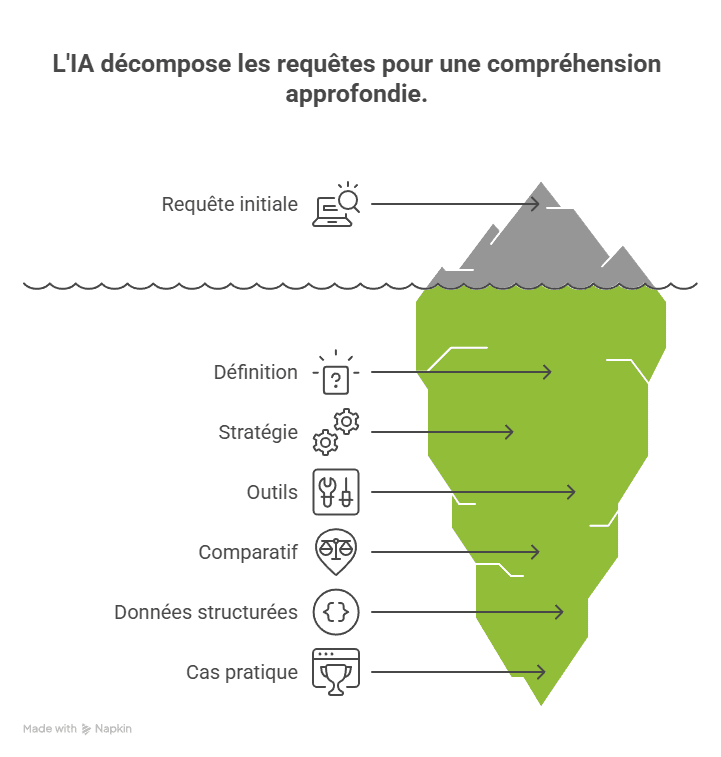
Let’s take a query related to our field: “How to improve my visibility on AI engines in 2026?”
The AI does not treat this question as a single block. It decomposes it:
| Detected Facet | Generated Sub-query |
|---|---|
| Definition | “What is visibility on AI engines” |
| Strategy | “GEO strategy 2026” |
| Tools | “Tools to measure AI visibility” |
| Comparison | “SEO vs GEO differences” |
| Structured data | “Schema markup for generative engines” |
| Case study | “Examples of sites ranking well on ChatGPT” |
If your site only covers “GEO strategy” without addressing tools, the SEO/GEO comparison, or markup, you are only answering a fraction of the sub-queries. The AI will look for the missing answers elsewhere — from your competitors.
Did you know? The Qwairy study published on Abondance (January 2026), covering 102,018 queries, shows that evaluative or decisional queries (“best”, “top”, comparisons) generate a significantly higher fan-out than simple factual queries. These are high commercial stake queries.
Linguistic bias: the invisible threat to non-English sites
43% of ChatGPT fan-outs are in English, even for a French prompt
This is the figure that should alert every SEO/GEO consultant. The study conducted by Peec AI in February 2026 on more than 10 million prompts and approximately 20 million fan-out queries reveals a structural imbalance.
Key results (source: Peec AI, reported by Abondance in February 2026 and Search Engine Journal):
- 43% of sub-queries generated by ChatGPT for non-English prompts are formulated in English.
- 78% of non-English sessions include at least one search query in English.
- No non-English market is below 60% of sessions containing an English fan-out.
What are the consequences for the visibility of French sites?
Fan-outs like “best X brands”, “top Y tools” create an English-language filter upstream. Only resources present on the English-speaking web are considered even before quality signals are evaluated.
Concrete consequences:
- Local French leaders can be made invisible in favor of global platforms.
- National brands disappear when the fan-out interprets the query as a search for “best global brands”.
- On sensitive topics, AI may prioritize English-language media, imposing a non-French editorial lens.
Action plan: protect your French visibility
- Create strategic pages in English — corporate pages, best-sellers, comparison pages. English fan-outs must be able to find you.
- Target English listicles — “best X tools”, “top Y agencies”. Being mentioned in this content increases your chances of appearing in fan-outs.
- Integrate English terms in your FR content — “best”, “top”, “review”, “vs” are identified fan-out triggers.
- Monitor your AI presence — tools like Cockpyt AI allow you to track your mentions and citations in LLM responses.
Is your site QFO-ready? The audit checklist
Here is the grid I use to audit a site’s preparation for query fan out. Each criterion corresponds to a lever directly linked to the AI’s query decomposition mechanism.
Semantic coverage: are you covering the latent field?
| Criterion | Audit Question | Status |
|---|---|---|
| Implicit FAQs | Does your content answer questions the user hasn’t formulated? | ✅ / ❌ |
| Semantic variants | Are synonyms and reformulations of the main keyword present? | ✅ / ❌ |
| Zero volume keywords | Do you cover zero-volume queries that are relevant to AI? | ✅ / ❌ |
| Thematic cluster | Is there a pillar page + satellite pages linked together? | ✅ / ❌ |
Technical structure: is your content extractable by AI?
| Criterion | Audit Question | Status |
|---|---|---|
| Schema markup | Are FAQPage, HowTo, Article implemented in JSON-LD? | ✅ / ❌ |
| Hn hierarchy | Do H2/H3 tags follow a logical structure without jumps? | ✅ / ❌ |
| Autonomous sections | Can each H2 block be extracted and understood alone (chunkable)? | ✅ / ❌ |
| Tables and lists | Is comparative data structured in clean HTML tables? | ✅ / ❌ |
Linking and topical authority
| Criterion | Audit Question | Status |
|---|---|---|
| Internal linking | Are the cluster pages linked by contextual links? | ✅ / ❌ |
| Topical authority | Does the site publish regularly on this theme? | ✅ / ❌ |
| External sources | Do third-party sites refer to your content on this subject? | ✅ / ❌ |
English presence and off-site signals
| Criterion | Audit Question | Status |
|---|---|---|
| EN Version | Do strategic pages exist in English? | ✅ / ❌ |
| English mentions | Are you cited in English comparisons or listicles? | ✅ / ❌ |
| AI Citations | Does your site appear in ChatGPT, Gemini, or Perplexity responses? | ✅ / ❌ |
| GEO Monitoring | Do you use a tool (Cockpyt AI, Qwairy) to track this visibility? | ✅ / ❌ |
Query fan out and GEO: how to adapt your strategy
From SEO to GEO: what changes concretely
Query fan out imposes a paradigm shift. The “one keyword = one page” logic is no longer enough. AI engines evaluate your content relative to all the sub-queries they generate — not just your target query.
Your site must function as a thematic hub: an exhaustive pillar page surrounded by satellite pages addressing every angle. This is the cluster strategy, aligned with the fan-out mechanism itself.
New KPIs to track
| KPI | What it measures | Possible tools |
|---|---|---|
| AI Visibility | Number of mentions and citations of your site in LLM responses | Qwairy, Peec AI, Cockpyt AI |
| Semantic coverage | Percentage of potential sub-queries covered by your content | Semrush, Surfer SEO |
| Qualified post-citation traffic | Clicks coming from AI responses to your site | Google Analytics 4, Matomo, Search Console |
| Topical authority | Depth and interconnection of the thematic cluster | Screaming Frog, Oncrawl |
FAQ: Query Fan Out
Does query fan out replace classic SEO?
No. The Qwairy study (January 2026, 102,018 queries) shows that simple factual queries trigger little fan-out. Classic SEO remains relevant for this type of search. Fan-out mainly impacts evaluative and decisional queries (“best”, “top”, comparisons). Both approaches complement each other.
What types of queries trigger the most fan-out?
Evaluative, comparative, and decisional queries generate the most sub-queries. The terms “best”, “top”, “list”, comparisons between products or services, and local searches (agencies, tools, providers) are the main identified triggers.
Can my site be cited by an AI without appearing on the first page of Google?
Yes. AI engines build their own corpus from fan-out sub-queries. Selection is based on semantic similarity and topical authority, not just classic Google ranking. A well-structured niche site can be cited without being in the top 10 on Google.
Should I create content in English to be visible in fan-outs?
For French sites targeting an international audience or operating in competitive markets, yes. Peec AI data shows that 43% of fan-outs are in English even for French prompts. At a minimum, corporate pages and strategic content deserve an English version.
How do I know if my content is used by ChatGPT or Gemini?
Tools like Qwairy, Peec AI, or Otterly allow you to track your mentions and citations in LLM responses. Without a dedicated tool, you can test manually by asking queries related to your expertise and observing if your site appears in the cited sources.
What is the difference between query fan out and classic query expansion?
Classic query expansion (synonyms, spelling corrections) broadens a single query. Query fan out goes further: it decomposes the query into autonomous sub-queries, executes them in parallel on multiple sources, then synthesizes an aggregated response. It is a multi-step process, not a simple lexical broadening.
Does query fan out have an impact on local SEO?
Yes, and a significant one. Local queries (“web agency in Nice”, “best restaurant in Bordeaux”) generate strong fan-out. The AI decomposes them into sub-queries: customer reviews, prices, services offered, local comparisons. A complete Google Business profile and structured localized content strengthen your visibility in these scenarios.