Getting referenced on ChatGPT means making your site visible where 900 million users ask their questions every week. OpenAI has transformed online search: Google is no longer the only reflex. For your business, appearing in ChatGPT’s responses depends on your content, your SEO and your credibility on the web.
Key Takeaways
- ChatGPT Search relies on the Bing index and its own parametric memory. Your organic ranking on Bing directly determines your chances of being cited.
- Brand authority (mentions, customer reviews, multi-platform presence) carries more weight than traditional backlinks for AI responses.
- Structured, up-to-date content enriched with schema.org structured data increases your visibility in generative engines by up to 40% (Princeton/IIT Delhi study, 2024).
- Allow OAI-SearchBot and ChatGPT-User crawlers in your robots.txt file. Blocking GPTBot does not affect your ChatGPT Search ranking.
How Does ChatGPT Search Find Its Answers?
ChatGPT does not generate its answers from nothing. OpenAI’s model combines two distinct mechanisms to respond to every user query.
Parametric Memory vs Real-Time Search (RAG)
The first mechanism is parametric memory. ChatGPT ingested billions of web pages, articles, books and forums during its training. When you ask a general question, it draws from this fixed knowledge base.
The second mechanism is RAG (Retrieval-Augmented Generation). When ChatGPT activates Search mode, it launches a real-time web search to supplement its memory. It queries the web, retrieves recent pages and synthesizes a sourced answer.
According to a Frase.io analysis (2025), around 60% of queries are handled by parametric memory alone. The remaining 40% trigger a web search via Search mode. The GPT-5.3 model, launched by OpenAI, automatically activates web search when it deems a question time-sensitive.
This dual mechanism has a direct consequence for your digital strategy: you need to both feed the parametric memory (being cited on authoritative sources) and be indexed for real-time search (solid technical SEO).
The Role of Bing and the Microsoft Index
ChatGPT Search uses the Bing index as its primary source for real-time searches. Microsoft, a major OpenAI shareholder, provides this infrastructure.
Your position on Bing determines your chances of being cited by ChatGPT. Multiple SEO experts have noted strong correlations between Bing results and ChatGPT Search citations.
However, an Ahrefs study (August 2025) reveals that 80% of URLs cited by ChatGPT do not appear in Google’s top 100 for the same query. ChatGPT builds its own citation ecosystem, based on content structure, authority signals and semantic relevance.
| Source | Usage | Impact on Your Visibility |
|---|---|---|
| Bing Index (Microsoft) | Real-time web search | High – primary source for Search mode |
| Parametric memory | Training knowledge | High – for general queries |
| Google (partial use) | Supplementary on ChatGPT Plus | Moderate – unofficial, observed by experts |
| Third-party sources (Wikipedia, YouTube, Reddit) | Contextual enrichment | High – 38% of AI citations come from 5 major domains |
Which OpenAI Crawlers Should You Allow?
OpenAI uses three web crawlers to access content on the web. Your robots.txt file determines which ones can index your site.
OAI-SearchBot, ChatGPT-User and GPTBot: What to Do in robots.txt?
Here is the role of each crawler and the recommended configuration:
- OAI-SearchBot: main crawler for ChatGPT Search. It indexes your pages for AI search results. Allow.
- ChatGPT-User: accesses your site in real time when a user asks a question. Allow.
- GPTBot: collects data for OpenAI model training. Blocking this bot does not affect your ChatGPT Search visibility. It’s your choice based on your privacy policy.
Example robots.txt configuration:
User-agent: OAI-SearchBot
Allow: /

User-agent: ChatGPT-User
Allow: /

User-agent: GPTBot
Disallow: /
OpenAI states that it takes approximately 24 hours between updating your robots.txt file and their systems reflecting the change.
Also check your indexation on Bing Webmaster Tools. If Bing cannot crawl your site, ChatGPT Search won’t find it either.
7 Actionable Levers to Get Cited by ChatGPT
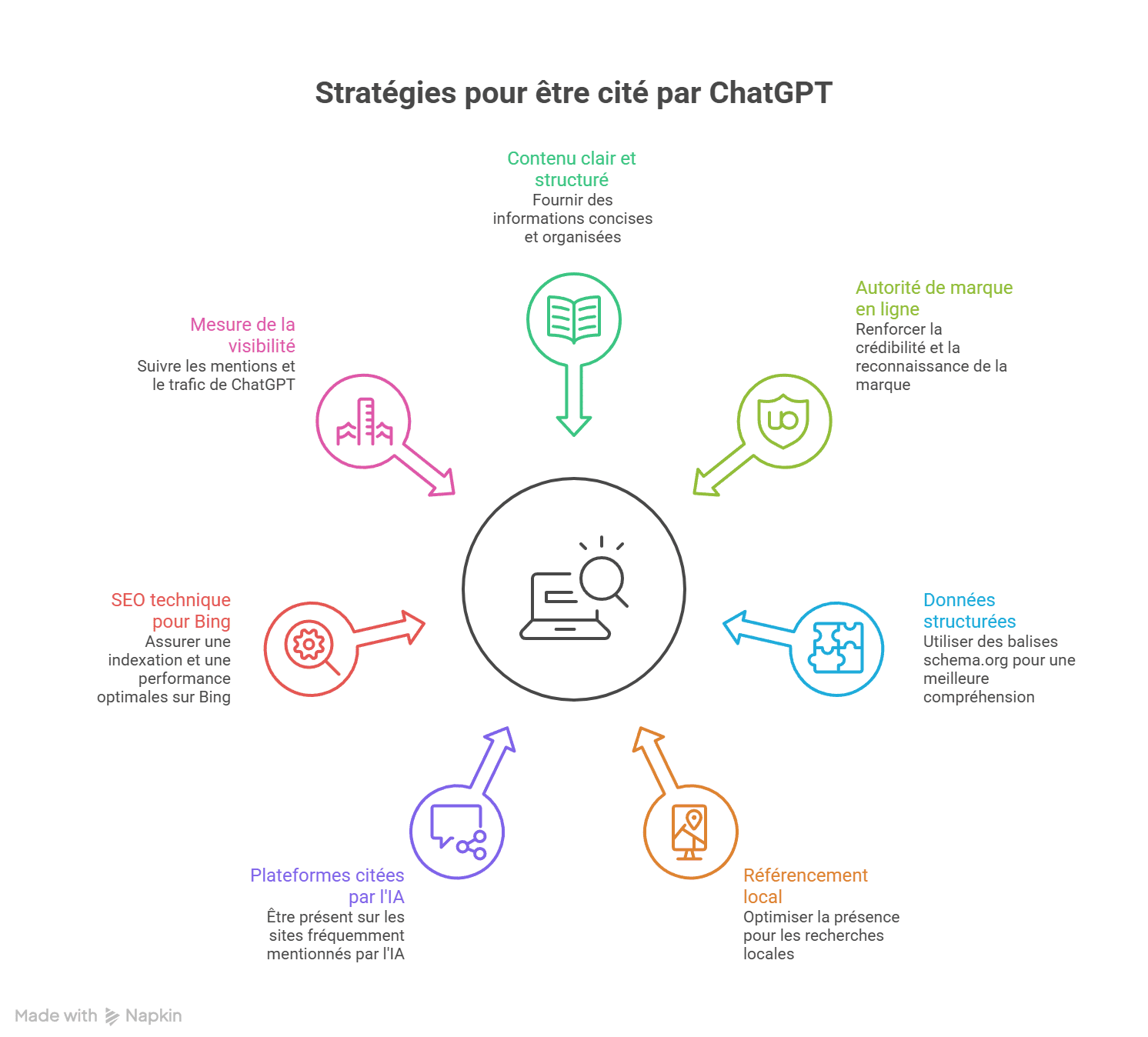 Getting referenced on ChatGPT relies on measurable actions. Here are the seven levers I recommend to my clients in 2026. Learn more in my complete AI referencing guide.
1. Produce Clear, Structured and Up-to-Date Content
ChatGPT favors content that directly answers a question. Place your answer in the first 50 words of each section. Use short paragraphs (300 characters max).
Structure your pages with a clean H1/H2/H3 hierarchy. The foundational GEO study (Princeton, Georgia Tech, IIT Delhi – published at KDD 2024) demonstrates that combining “readability optimization + statistics addition” outperforms any isolated GEO strategy by over 5.5%.
Update your articles regularly. Add a visible “Last updated” date. Generative engines favor fresh content for time-sensitive queries.
Include verifiable statistics every 150 to 200 words. Cite your sources. Quality content with precise data increases your chances of being cited by ChatGPT, Perplexity and Google AI Overviews.
2. Strengthen Your Online Brand Authority
Brand mentions carry more weight than backlinks for AI responses. According to Position Digital (2026), web brand mentions have the strongest correlation (0.664) with AI Overview appearances – compared to just 0.218 for backlinks.
How to build authority:
- Publish guest articles on high-credibility sites in your field
- Get cited in trade press and online media
- Participate in relevant discussions on Reddit, LinkedIn and YouTube
- Collect customer reviews on Google My Business, Trustpilot and your industry platforms
Reddit, LinkedIn and YouTube were among the most cited sources by LLMs in October 2025. Your presence on these platforms directly feeds AI responses.
3. Optimize Structured Data (schema.org)
Structured data helps ChatGPT and other generative engines understand the context of your content. Use Article, FAQPage, HowTo, Organization and LocalBusiness schemas according to your business.
Clean schema.org markup facilitates information extraction by RAG systems. When ChatGPT Search retrieves your page, structured data lets it immediately identify the topic, author, date and key answers.
Validate your markup with Google’s Rich Results Test or Schema Markup Validator. Integrate JSON-LD in the head of each page.
4. Work on Your Local SEO
For local queries, ChatGPT displays an interactive map. It selects businesses based on local press articles, activity guides, TripAdvisor and online rankings.
Actionable steps for your local SEO:
- Optimize your Google Business Profile with complete, up-to-date information
- Register your business on Bing Places for Business
- Get listed in local directories in your sector
- Collect recent customer reviews and respond to them
- Target local rankings and guides (“best [profession] in [city]”)
Local SEO on ChatGPT depends less on the Google listing alone and more on your overall presence across trusted third-party sources.
5. Be Present on Platforms Cited by AI
The five most-cited domains in AI responses are Wikipedia, YouTube, Reddit, Google properties and Amazon (The Digital Bloom study, 2025). They account for 38% of all AI citations.
Create useful content on these platforms. A well-optimized YouTube video, a relevant Reddit thread or a sourced Wikipedia page directly feed LLM parametric memory and Search mode results.
For a business, publishing on YouTube and LinkedIn is a measurable GEO investment. Social media no longer just serves communication: they fuel responses from ChatGPT, Gemini, Perplexity and Claude.
6. Configure Your Technical SEO for Bing
Technical SEO for Bing resembles Google SEO, with a few specificities:
- Submit your XML sitemap in Bing Webmaster Tools
- Ensure fast loading speed (Bing is sensitive to this)
- Use optimized meta description and title tags
- Avoid duplicate content and Black Hat practices
- Use optimized media: images with alt text, videos with subtitles
Bing explicitly recommends creating content for users, not for bots. A well-indexed site on Bing has better chances of appearing in ChatGPT Search responses.
7. Measure Your Visibility in AI Responses
You can’t optimize what you don’t measure. Here’s how to check if ChatGPT cites your site:
- Manual testing: ask ChatGPT queries related to your business in Search mode. Note whether your brand is cited and in what context.
- Google Analytics 4: filter traffic by source. Visits from ChatGPT appear as referral “chatgpt.com”.
- Specialized tools: I co-founded Cockpyt AI, which lets you track your mentions in AI responses, your share of voice and the associated sentiment.
In 2026, only 16% of brands systematically measure their AI response performance. This is a window of opportunity for businesses acting now.
Key point: ChatGPT generates 87.4% of AI referral traffic to websites (The Digital Bloom, 2025). Optimizing your content for ChatGPT means capturing the largest share of AI traffic.
GEO and SEO: What’s the Difference for Your Digital Strategy?
GEO (Generative Engine Optimization) does not replace SEO. It adds as an additional layer. Your organic ranking on Google remains the foundation. GEO adds requirements around structure, citations and data richness.
| Criterion | Traditional SEO | GEO (Generative Engine Optimization) |
|---|---|---|
| Objective | Rank a page in Google results | Get cited in an AI-generated response |
| Key metric | Position, CTR, organic traffic | Citation rate, AI share of voice, sentiment |
| Main signal | Backlinks, keywords, content | Brand mentions, structured data, freshness |
| Content format | Page optimized for a keyword | Structured content, direct answers, sourced statistics |
| Target platforms | Primarily Google | ChatGPT, Perplexity, Gemini, Claude, AI Overviews |
The GEO study from Princeton, Georgia Tech and IIT Delhi (published at the KDD 2024 conference) formalized this field. Their tests show that combined GEO techniques can increase visibility in AI responses by up to 40%. The most effective methods: adding statistics, citing sources and optimizing readability.
According to Gartner, the volume of traditional search engine queries could drop by 25% by the end of 2026 in favor of AI chatbots and virtual agents. AI-referred web sessions jumped 527% year-over-year (Previsible, 2025 report).
For an entrepreneur, the most cost-effective strategy is to consolidate your existing SEO and graft GEO practices onto it: structured content, direct answers, hard data, brand authority and multi-platform presence.
FAQ – Frequently Asked Questions About ChatGPT Referencing
Do I need to pay to appear in ChatGPT responses?
No. ChatGPT Search referencing is organic. There is no (as of 2026) advertising system integrated into ChatGPT responses. Your visibility depends on your content quality, your authority and your Bing indexation.
Can ChatGPT cite a small site without strong domain authority?
Yes. The Ahrefs study (August 2025) shows that 80% of URLs cited by ChatGPT do not appear in Google’s top 100. ChatGPT values contextual relevance and content structure, not just traditional domain authority.
How long does it take to get referenced on ChatGPT?
There is no guaranteed timeline. If your site is already well-indexed on Bing and your content is structured, you may appear within weeks of publication. Robots.txt updates are processed within 24 hours by OpenAI.
Is Google SEO enough to appear on ChatGPT?
Not always. ChatGPT primarily relies on the Bing index, not Google. Good Google SEO is an asset, but you must also verify your Bing presence and optimize your content for GEO criteria (structure, citations, structured data).
How can I tell if ChatGPT cites my site?
Test manually by asking business-related queries in Search mode. Also check your Google Analytics 4 reports for referral traffic from chatgpt.com. Specialized tools like Semrush Enterprise AIO enable automated tracking.
What’s the link between ChatGPT and Google AI Overviews?
They are two distinct systems. Google AI Overviews uses the Google index. ChatGPT Search uses the Bing index. Citation criteria partially overlap (structured content, authority, freshness) but rankings differ.
Will GEO replace SEO?
No. GEO complements SEO. Google retains about 90% of traditional search market share in 2026. GEO gives you access to an additional channel: generative responses. The best approach is to integrate GEO into your existing SEO strategy.
Sources
-
- Aggarwal, P. et al. – “GEO: Generative Engine Optimization” – ACM KDD 2024 – arxiv.org/abs/2311.09735
- DemandSage – “ChatGPT Statistics 2026” – March 2026 – demandsage.com/chatgpt-statistics
- First Page Sage – “Google vs ChatGPT Market Share: 2026 Report” – April 2026 – firstpagesage.com
- Previsible – “2025 AI Traffic Report” – 2025 – Cited via Frase.io – frase.io
- Ahrefs – ChatGPT Citation Analysis – August 2025 – https://ahrefs.com/blog/ai-overview-change/
- Position Digital – Brand Mentions / AI Overviews Correlation – 2026 – https://www.position.digital/blog/ai-seo-statistics/
- The Digital Bloom – Top 5 AI-Cited Domains – 2025 – https://thedigitalbloom.com/learn/google-ai-overviews-top-cited-domains-2025/