Key takeaways:
- Measuring your AI visibility relies on 7 KPIs: citation rate, share of voice, mention volume, sentiment, position in the answer, AI referral traffic and conversions.
- Organic CTR drops 61% when an AI Overview appears: tracking your Google ranking is no longer enough (Seer Interactive, 2025).
- My 3-level framework (presence, weight, consequence) turns a “felt” visibility into measurable tracking.
- You can build a first free baseline in 10 minutes, with no paid tool.
And your brand — does ChatGPT recommend it?Measure your presence in AI and spot the competitors cited in your place. No credit card, first scan in 5 min.
What are the KPIs to measure your visibility in generative AI?
Seven KPIs are enough to track your presence in generative engines. They answer three simple questions. Are you cited? In what position? With what effect on your business?
These are the indicators that show up in every serious methodology on the market. I have grouped them so you know what to measure starting today.
| GEO KPI | What it measures | Where to track it |
|---|---|---|
| Citation Rate | How often your content is used as a cited source | GEO tool, manual tracking |
| Brand Mentions | Number of AI answers that name your brand | GEO tool, test prompts |
| AI Share of Voice | Your share of citations versus competitors | GEO tool |
| Brand Sentiment | Tone of the mention (positive, neutral, negative) | Qualitative analysis |
| Position in the answer | Where your brand sits (opening or end of paragraph) | Reading the answers |
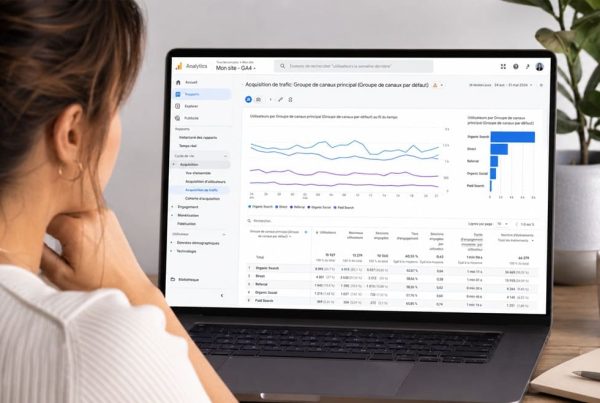
| AI Referral Traffic | Visits sent by ChatGPT, Perplexity, Gemini | GA4, Plausible |
| Attributed conversions | Leads and sales from AI traffic | GA4, CRM |
Do not track all seven on day one. Start with three: mention volume, share of voice and AI referral traffic. Add the rest once your tracking is running smoothly.
Why are classic SEO KPIs no longer enough in 2026?
Your average position on Google no longer reflects your real visibility. A user gets the answer straight from the AI, without clicking. Your page can stay first and still lose traffic.
The numbers confirm this shift. Organic click-through rate drops 61% on informational queries when a Google AI Overview appears (Seer Interactive, November 2025). That study covers more than 3,100 queries analyzed between June 2024 and September 2025.
Gartner expects a 25% drop in traditional search volume by 2026, in favor of AI chatbots and virtual agents (Gartner, February 2024). The point of contact is moving. Your KPIs must follow.
The angle nobody measures: AI-referred traffic reportedly converts up to 4.4 times better than standard organic traffic, because the visitor arrives already informed and further along in their decision (secondary source, to be verified). An AI mention is therefore often worth more than a classic Google click.
Another solid data point: pages cited in an AI Overview earn 35% more organic CTR than uncited pages (Seer Interactive, 2025). Being the AI’s source still pays off. You just have to measure it.
The 3-level framework: presence, weight, consequence
I organize every GEO KPI into three levels of reading. This framework keeps a business owner from drowning under twelve indicators. Each level answers a precise business question.
- Level 1 : Presence: does your brand appear in the answer?
- Level 2 : Weight: in what position, and with what tone?
- Level 3 : Consequence: what does it earn you?
Level 1: presence (are you cited?)
Presence is measured with mention volume and citation rate. You ask your strategic queries to the AIs. You note whether your brand appears. A raw score comes out: across 20 industry prompts, I appear in 8 answers, or 40%.
That score is your starting point. Without presence, the other two levels do not exist. It is the foundation of GEO tracking.
Level 2: weight (in what position and with what sentiment?)
Appearing is not enough. A brand cited in the first sentence carries more weight than one pushed to the end of a paragraph. AI share of voice compares your share of citations to your competitors’ on the same queries.
Add sentiment. A mention can be positive, neutral or negative. An AI that cites you as an “option to avoid” damages your image as much as an absence. Read your mentions, do not just count them.
Level 3: consequence (traffic and conversions)
Level 3 links visibility to revenue. AI referral traffic is measured in GA4: you spot sessions coming from chatgpt.com, perplexity.ai or gemini.google.com. You then track their conversions.
This level justifies the GEO investment to your management. A mention that generates a qualified lead is worth more than ten Google positions with no clicks. That is where ROI is proven.
How do you build a free baseline in 10 minutes?
A baseline is your starting snapshot. Without it, you will never know whether you are progressing. Here is the method I use with my clients, with no paid tool.
- List 10 strategic queries. Use the questions your prospects actually ask: “best [your trade] in [your city]”, “how to choose a [your product]”.
- Ask each query to 3 AIs. ChatGPT, Perplexity and Gemini are enough to start. Use the free versions.
- Note three things per answer. Is your brand cited (yes/no)? In what position? Which competitors appear?
- Calculate your presence rate. Number of citations divided by number of queries. You get your starting score.
- Date the table. Repeat the exercise every month to measure progress.
This manual method has one limit: it does not scale. To track hundreds of prompts continuously, an automated tool becomes useful. I cover that next.
Which tools track your AI visibility in 2026?
Two families of tools work together. GEO platforms measure your citations inside the AIs. Analytics tools measure the traffic those AIs send you. You need both.
For citations and share of voice, specialized platforms query the main LLMs every day with your prompts. Cockpyt AI, which I co-founded, tracks your presence across ChatGPT, Gemini, Perplexity and Claude, then spots the competitors cited in your place. Other players exist on the market.
For AI referral traffic, GA4 and Plausible do the job for free. Create a segment that isolates the chatgpt.com, perplexity.ai and gemini.google.com sources. Search Console rounds out the analysis on the AI Overviews side.
How often should you measure, and how do you avoid the traps?
Measure your GEO KPIs at least once a month. AI answers move fast. Weekly tracking suits highly competitive brands; monthly tracking is enough for a small business.
The first trap is volatility. The same query returns two different answers ten minutes apart. Never draw a conclusion from a single test. Run several and reason in averages.
The second trap is personalization. The AI adapts its answer to the account history. Test in private browsing or via a neutral account to get a comparable measurement.
The third trap is the prompt sample. Ten queries give a trend, not a statistical truth. Gradually expand your list to make your share of voice more reliable.
FAQ: measuring your visibility in generative AI
What is the difference between an SEO KPI and a GEO KPI?
An SEO KPI measures your ranking in a list of links (position, clicks, impressions). A GEO KPI measures your integration into a generated answer: are you cited, in what position, and with what impact. SEO measures display, GEO measures how the model uses your content.
What exactly is AI share of voice?
It is your share of citations versus competitors across the same set of queries. If an AI cites five brands on a question and you are one of them, your share of voice is 20% on that query. Aggregated over dozens of prompts, it reveals your real weight in your sector.
How do you measure traffic from ChatGPT in GA4?
Create an exploration or a segment filtering session source on the AI domains: chatgpt.com, perplexity.ai, gemini.google.com. GA4 often classifies this traffic as “referral”. You then track sessions, engagement rate and conversions for that segment.
How many prompts should you track for a reliable measurement?
Ten prompts give a first usable trend. For a reliable share of voice, aim for thirty to fifty queries covering your main topics. Beyond that, an automated tool becomes necessary to keep pace.
Does GEO replace SEO?
No. GEO builds on SEO. Content that already performs on Google is statistically more likely to be picked up as a source by the AIs. Solid SEO remains the foundation that feeds your visibility in generative engines.
Can you measure your AI visibility for free?
Yes, to get started. The manual method (asking your queries to the free versions of ChatGPT, Perplexity and Gemini, then noting your citations) costs nothing. GA4 tracks referral traffic for free. Paid tools automate this work once you scale.
Sources:
- Seer Interactive, “AIO Impact on Google CTR: September 2025 Update”, November 2025 — seerinteractive.com (61% organic CTR drop, +35% CTR for cited pages)
- Gartner, “Gartner Predicts Search Engine Volume Will Drop 25% by 2026”, February 2024 — gartner.com
- AI traffic conversion data (×4.4): secondary source, to be verified before commercial use.