Key takeaways
- The Google ranking you see in your browser is never your real ranking: browsing history and location distort it.
- A plugin like Yoast or RankMath does not do the ranking work for you, it guides you on a keyword you choose yourself.
- A single page can and should target several related keywords, not one isolated term.
- SEO rests on 4 interdependent pillars (technical, content, user experience, authority): you cannot optimize without touching your site, and in 2026 GEO adds a fifth challenge, being cited by generative AI.
I have worked as a WordPress SEO consultant in Nice since 2016. I talk every week with small business owners, e-commerce merchants and web project owners. The same beliefs come up again, still in 2026, and they hold entire strategies back.
Does ChatGPT recommend your brand?Measure your presence and spot the brands cited instead of you. No credit card required.
SEO for beginners, what is it in one sentence?
SEO covers the techniques that rank your site in Google’s organic results, without paid advertising. Looking for the full definition and the 4 pillars of SEO in detail? I have written a dedicated article on that question.
Related reading: What is SEO? Definition and the 4 pillars in 2026
What I offer here are the 7 beliefs that actually block beginners in practice, updated for 2026.
Why is your Google ranking never the one you see?
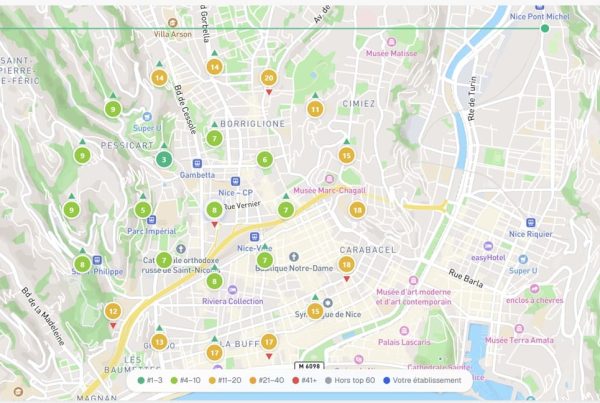
You type your keyword, you see yourself in 3rd position, and you conclude that this is your real ranking. That is wrong. Google personalizes every result based on your browsing history and your location. Another visitor, at the same moment, will see a different ranking for the same query.
Two mistakes come up constantly with my clients:
- They do not check whether the keyword they want to win is actually searched in Google.
- They confuse the ranking they see on screen with a reliable average ranking.
An SEO ranking is measured with a dedicated tracking tool (Google Search Console for a first level, a rank tracking tool for daily monitoring), never by typing the query yourself. This average ranking depends on the actual search volume of the keyword: a term ranked 1st but never searched brings you no traffic at all.
Is a competitor ranked first necessarily the best SEO expert?
No. This belief rests on the same confusion as the previous one: location and browsing history distort the ranking you observe. A consultant based in Nice will appear at the top more easily for a visitor located in Nice than a competitor based in Lyon, on the same query.
Skill can never be reduced to a single Google screenshot. The keywords worked on matter as much as expertise itself: a consultant can be excellent on “seo consultant nice” and never have worked on “seo freelancer”. In my view, the right move before choosing a provider is to compare several searches, on several keywords, rather than trust a single result.
Do Yoast SEO or RankMath really improve your rankings?
No, these plugins do not rank anything by themselves. They analyze your page around a keyword you enter manually and give you optimization advice. Turning every indicator green guarantees no Google ranking.
Two concrete limits to know in 2026:
| What a beginner assumes | The SEO reality |
|---|---|
| Green indicator = good ranking | Green indicator = consistent optimization for the keyword entered, nothing more |
| The plugin picks the right keyword | Only you choose the keyword, a wrong choice makes the analysis useless |
| The data is always reliable | A poorly configured page builder can distort the plugin’s analysis |
Follow Google’s official recommendations for page optimization instead, and treat the plugin as an assistant, never as a final judge.
Should you target a single keyword per page?
No, that actually contradicts the long-tail principle. A well-built page targets one main keyword plus several related secondary keywords. Limiting yourself to one term means giving up a large share of the available search volume on a topic.
In my WordPress SEO training, I have students work on a two-column keyword file: the main keyword, then the secondary variants to weave naturally into the same page.
Does a minimalist site rank better than a content-rich one?
No, Google relies first on text to understand and rank a page. A very bare site, with little content, sends few usable signals to search engines. Google recommends a minimum of 600 words per page, I recommend closer to 1000 words for solid visibility on a competitive topic.
That does not mean stacking indigestible blocks of text. With WordPress, layout elements (tabs, accordions, structured text) let you add useful content without hurting readability. User experience and content volume are not opposites, they work together.
Should your domain name contain your main keywords?
No, the weight of the domain name in Google’s algorithm stays very low, precisely to avoid over-optimized, keyword-stuffed domain names. My training students often spend a disproportionate amount of time on this choice.
A clear domain name, memorable for your customers, is largely enough. The extension itself (.com, .fr) has no direct impact on rankings.
Can you improve your SEO without touching your site?
No, SEO rests on 4 interdependent pillars and at least two of them require direct changes to the site:
- Technical: structure, architecture, indexing, everything under the hood.
- Content: Google favors text, which means adding or reworking pages.
- User experience: load time, mobile version, usability.
- Authority: external recommendations, backlinks and mentions, the only pillar that does not directly touch the site.
Bulk tier-2 link building remains a practice to handle with care: Google Search Central explicitly lists it among the tactics covered by its spam policies, and a technical or editorial audit prepared without care never makes up for artificial link building.
SEO for beginners in 2026: does GEO really change the game?
Yes, a fifth challenge now sits alongside the 4 historical pillars: getting cited by AI answer engines such as ChatGPT, Perplexity or Gemini. An Ahrefs study from March 2026 found that only 38% of citations in AI Overviews come from pages ranked in Google’s top 10, down from 76% in July 2025. Ranking well no longer guarantees visibility in AI answers.
In my view, this figure does not make SEO obsolete, it confirms instead that a site’s indexability and semantic coverage matter more than a top-10 ranking alone. GEO extends SEO, it does not replace it.
That is exactly what I built Cockpyt AI to track, the tool I co-founded to monitor a brand’s presence in ChatGPT, Perplexity and Gemini answers, with Google AI Overview and AI Mode tracking currently in development.
Find out who gets cited instead of you on your key queriesA GEO visibility audit in a few minutes, no commitment.
Related reading: What Are Google’s Algorithms in 2026?
Frequently asked questions about SEO for beginners
Is SEO really free?
Organic search does not cost direct ad spend, unlike paid search. It does require time, or a budget for a service provider, for content, technical work and monitoring.
How long before you see SEO results?
Expect roughly 4 to 6 months before noticing measurable first effects on a site that is already indexed, longer for a brand new site or a highly competitive topic.
Does SEO work the same way for ChatGPT as for Google?
No, AI answer engines rephrase information instead of showing a list of links. A site still needs to stay indexable and semantically clear to get cited, which builds on SEO fundamentals without stopping there.
Do you need a blog to rank well?
A blog makes it easier to publish text content regularly, a signal Google values, but it is not mandatory if your service pages already cover your semantic field well.
What is the difference between SEO and paid search for a beginner?
SEO captures lasting organic traffic with no cost per click, paid search (Google Ads) captures immediate traffic against an ad budget. The two complement each other rather than compete.
Is a tool like Yoast enough to rank well?
No, an optimization plugin remains an advisory tool built around a manually chosen keyword, not a ranking guarantee, as detailed earlier in this article.
Primary sources:
- Ahrefs, “AI Overviews Citation Study”, March 2026: breakdown of AI Overview citations by Google ranking.
- Google Search Central, “Spam policies”: Google’s policies on artificial link building.